Business
9 Mins
Nov 11, 2025
Algorithmic, Quantitative, and Systematic Trading: Understanding the Differences and Choosing the Right Approach
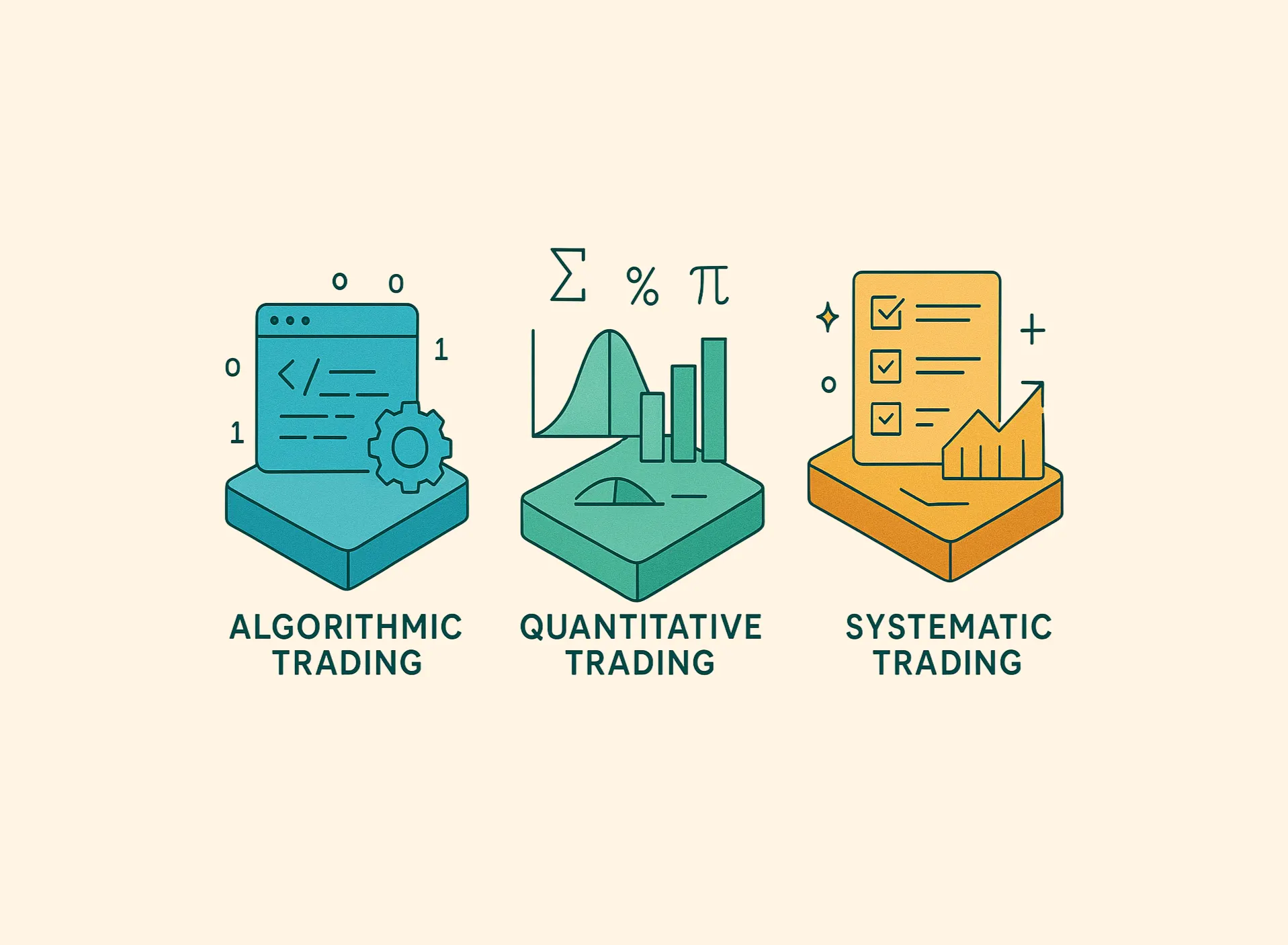
In today’s markets, speed and precision can make the difference between a profitable trade and a missed opportunity. Technology has transformed investing, giving rise to strategies that rely on data, automation, and rigorous decision-making. Among these, algorithmic trading, quantitative trading, and systematic investing are often mentioned interchangeably-but they are far from identical.
Understanding the nuances of each approach is critical for investors who want to leverage data-driven strategies while avoiding common pitfalls. In this article, we break down what sets these methodologies apart, explore their benefits and limitations, and highlight why systematic trading is often the ideal starting point for beginners.
What is Algorithmic Trading?
Algorithmic trading-often shortened to “algo trading”-uses computer programs to execute trades automatically. These algorithms follow predefined rules, analyzing vast amounts of market data to make rapid trading decisions. The core idea is simple: let computers handle the speed and complexity that humans cannot match.
Why traders use algo trading:
Speed and efficiency: Algorithms can execute trades in milliseconds, capturing fleeting opportunities.
Complex strategy execution: Strategies too intricate for manual execution-like multi-leg arbitrage trades-can be implemented seamlessly.
Emotion-free decisions: By following rules, algo trading avoids panic selling or impulsive buying.
Risks to watch for:
Technical failures or connectivity issues can cause significant losses.
Over-reliance on algorithms may overlook unexpected market events.
In extreme cases, poorly designed algorithms can amplify market volatility, contributing to flash crashes.
Example: A momentum-based algorithm might automatically buy a stock when it breaks above a 50-day moving average and sell when it dips below, executing orders faster than any human trader could.
What is Quantitative Trading?
Quantitative trading-or “quant trading”-takes data-driven strategies one step further. It uses mathematical models to identify trading opportunities and make investment decisions. Rather than relying solely on price movements, quant trading evaluates patterns, correlations, and anomalies across markets.
Benefits of quant trading:
Data-driven objectivity: Decisions are based on statistical evidence, not intuition or hype.
Risk management: Models can simulate scenarios and optimize portfolio exposure.
Market inefficiency exploitation: Quant strategies can uncover opportunities invisible to traditional investors.
Risks:
Building and maintaining mathematical models is resource-intensive and requires expertise in both finance and data science.
Models rely on historical data, which may not fully predict future conditions.
Popular quant strategies can become overcrowded, reducing profitability.
Example: A quant model might detect that a company’s stock historically rises after specific earnings patterns, allowing a trader to anticipate opportunities across multiple stocks simultaneously.
What is Systematic Trading?
Systematic trading is a structured, rules-based approach to investing. It blends elements of algo and quant strategies but emphasizes repeatable processes that minimize discretion and emotional bias. Trades are executed according to pre-established criteria, which can be tested and refined using historical data.
Advantages:
Discipline and consistency: Reduces impulsive decision-making.
Backtesting: Strategies can be validated before real money is committed.
Automation-ready: Systems can execute trades automatically without constant monitoring.
Risks:
Overly rigid rules may underperform in unusual market conditions.
Requires careful maintenance and adjustment as markets evolve.
Example: A systematic trader might decide to buy stocks with earnings growth above 15% and a P/E ratio below 20, selling only when earnings decline or valuations exceed thresholds-every trade guided by the same rulebook.
Comparing the Three Approaches
Aspect | Algorithmic Trading | Quantitative Trading | Systematic Trading |
Decision Making | Rule-based execution of trades | Data-driven using mathematical models | Rule-based, systematic framework |
Focus | Speed and efficiency | Model development and statistical analysis | Discipline and consistent framework |
Emotions/Bias | Minimizes emotional bias | Reduces emotion via data analysis | Reduces subjective decision-making |
Strategy Complexity | Can execute complex, automated strategies | Involves complex quantitative models | Uses predefined, repeatable rules |
Skill Requirements | Programming and algorithm knowledge | Finance, math, and data analysis expertise | Understanding of rules and systematic frameworks |
Shared Traits: All three approaches rely on data, automation, objective decision-making, and disciplined risk management. Each aims to remove human emotion from trading, improve efficiency, and make the most of market opportunities.
Why Systematic Trading is Great for Beginners
For investors just starting out, systematic trading offers a clear, structured path. It provides:
Predefined rules: Eliminates guesswork and impulsive trades.
Confidence through backtesting: Historical data lets beginners see how strategies might have performed.
Learning foundation: Helps investors understand the market’s behavior in a controlled, methodical way.
GoAlpha integrates this approach seamlessly, giving users access to quant models, automated signals, and real-time data to implement systematic strategies without being overwhelmed. Beginners can start small, follow a disciplined framework, and grow their understanding over time.
Conclusion
Algorithmic, quantitative, and systematic trading are reshaping the investment landscape, each offering unique strengths. Algo trading excels in speed, quant trading leverages data and mathematical rigor, and systematic trading provides discipline and repeatability.
For newcomers, systematic trading often serves as the best entry point-a way to learn, build confidence, and adopt data-driven principles. For experienced investors, combining elements of all three can unlock powerful strategies.
The future of investing is data-driven, and tools like GoAlpha make it possible for investors to harness this power effectively. By embracing objective, systematic approaches, traders can navigate markets with confidence, clarity, and the potential to achieve consistent, long-term success.