Business
8 Mins
Nov 6, 2025
Growth vs Value Investing: Which One Is Right for You?
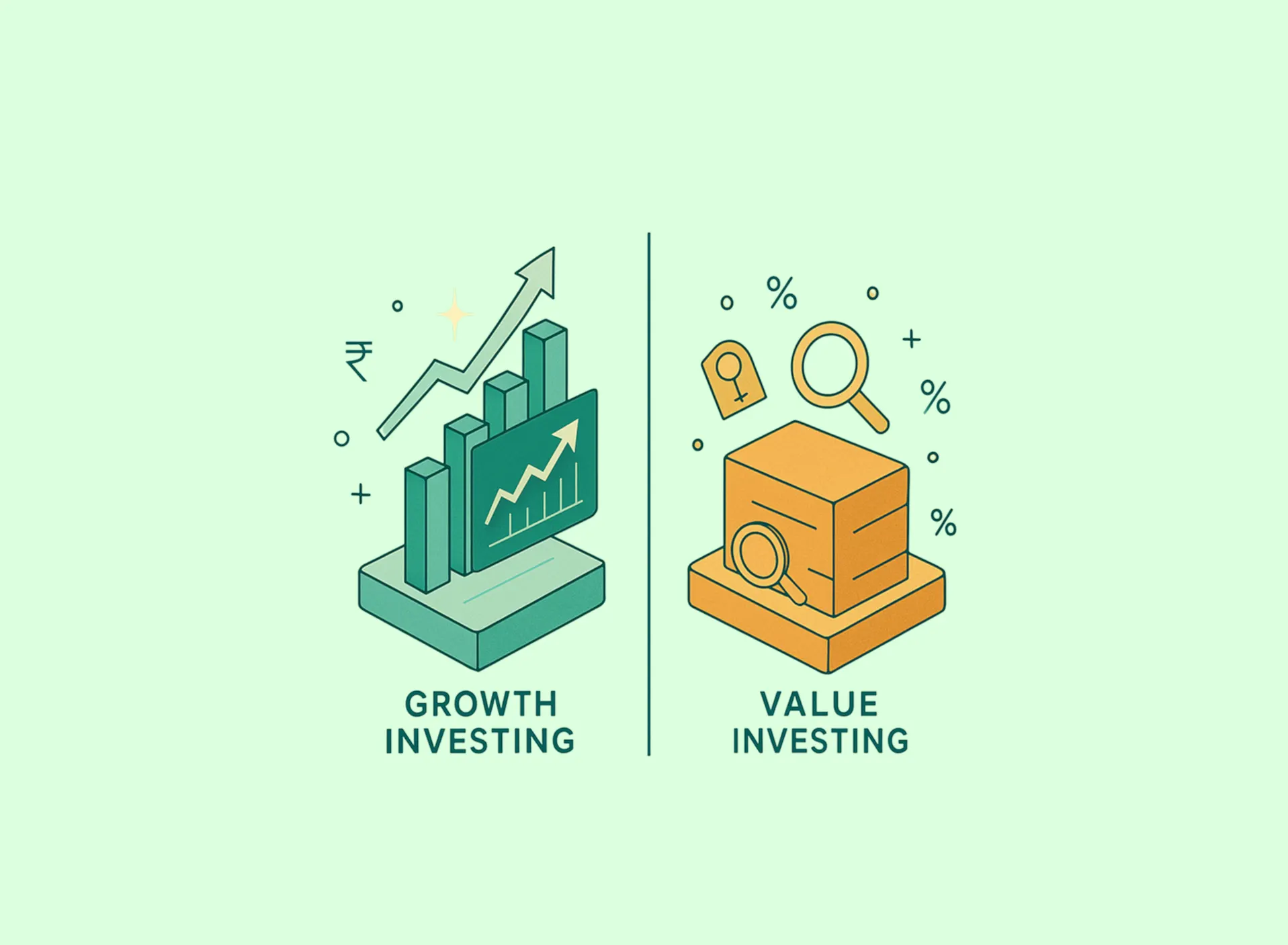
Investing can sometimes feel like stepping into a maze with endless paths and choices. Active vs passive strategies, index funds vs sector bets, short-term trading vs long-term holding - the options can overwhelm even experienced investors. Among these choices, one fundamental question often stands out: should you focus on growth stocks or value stocks?
Understanding the difference is more than just labels. It’s about your risk appetite, financial goals, and investing philosophy. Let’s break it down in a practical, easy-to-grasp way, and see how modern tools like GoAlpha can help you navigate this classic investing dilemma.
What Are Value Stocks?
Value stocks are the steady, understated players of the stock market. These are companies that the market undervalues despite strong fundamentals. Think of them as hidden gems - solid businesses trading below what they’re truly worth.
But how do you spot them? Investors often look at key metrics:
Price-to-Earnings (P/E) Ratio - compares a stock’s market price to its earnings per share. A lower P/E suggests the stock might be undervalued.
Price-to-Book (P/B) Ratio - compares the market price to the company’s book value. A low P/B can indicate that the stock is trading below its asset value.
Dividend Yield - higher dividend yields suggest companies that return profits to shareholders, often a sign of financial stability.
Value investing isn’t about chasing flashy growth or headlines. It’s a disciplined strategy: analyze financial metrics, identify mispriced opportunities, and invest patiently while the market eventually recognizes the stock’s true value.
What Is Value Investing?
Value investing, popularized by legends like Benjamin Graham and Warren Buffett, is the art of buying undervalued stocks with strong fundamentals and holding them until their true worth is recognized.
This strategy requires:
Deep research into financial statements and company performance
Patience to withstand market fluctuations
Confidence that markets occasionally misprice companies
The essence of value investing is trusting the process. You’re not reacting to every market swing - you’re relying on data, fundamentals, and the long-term potential of quality companies.
What Are Growth Stocks?
If value stocks are the steady tortoise, growth stocks are the high-speed hare. These are companies growing at an above-average pace, often reinvesting profits to expand rather than paying dividends.
Growth stocks appeal to investors looking for:
Rapid revenue and earnings growth
Innovation and market disruption
Long-term capital appreciation potential
Investing in growth stocks is a bit like placing a calculated bet on the future. These companies might seem expensive today, but the expectation is that their earnings growth will eventually justify the higher price.
What Is Growth Investing?
Growth investing is about spotting businesses on the brink of significant expansion. Investors focus on metrics like:
Revenue growth rate
Earnings per share (EPS) growth
Market share gains and industry potential
Growth investors accept higher volatility because the potential rewards can be substantial. The strategy rewards patience and a forward-looking mindset - buying not just for what a company is today, but for what it could become.
Comparing Investment Styles: Growth vs Value
Criteria | Value Investing | Growth Investing |
Investment Philosophy | Seeks undervalued stocks with strong fundamentals | Targets stocks with high growth potential |
Risk Tolerance | Lower volatility, focus on downside protection | Higher volatility, accepting short-term swings for potential gains |
Time Horizon | Typically longer-term | Often shorter-term, growth-driven |
P/E Ratio | Prefers lower P/E ratios | Accepts higher P/E ratios for growth potential |
P/B Ratio | Looks for low P/B ratios | May not prioritize P/B ratios as much |
Dividend Yield | Emphasis on higher dividend yield | Usually forgone as profits are reinvested |
Market Capitalization | Often in large, established companies | Often smaller, high-growth companies |
Which Approach Is Better?
The truth is, there’s no one-size-fits-all answer. The better strategy depends on your risk tolerance, investment horizon, and market conditions.
Value Investing Considerations:
Stability and dividends from mature companies
Attractive during market downturns for downside protection
Patience is rewarded as the market corrects mispriced stocks
Growth Investing Considerations:
Potential for high capital appreciation
Works well in industries experiencing innovation or disruption
Requires tolerance for volatility and short-term market swings
For many investors, the smart approach is a mix of both. Combining value and growth stocks allows you to balance stability with potential upside. It’s also a great way to stay adaptable as markets and industries shift over time.
How GoAlpha Helps You Navigate Growth and Value
Here’s where modern tools come in. GoAlpha’s quant-based models help investors objectively evaluate both growth and value opportunities. Instead of relying on tips or speculation, GoAlpha offers:
Real-time quant signals to identify high-probability trades
AI-powered news insights to stay ahead of market trends
Portfolio tracking to monitor both growth and value holdings without constant stress
Seamless trading integration with top brokers for quick execution
By combining data, AI insights, and disciplined strategy, GoAlpha lets investors take a more informed approach - whether your heart leans toward the stability of value or the excitement of growth.
Final Thoughts
Growth vs value isn’t about picking a winner - it’s about understanding your goals, risk tolerance, and investment horizon. A thoughtful mix of both strategies, guided by data and disciplined analysis, can help you build a portfolio that balances stability and growth.
With tools like GoAlpha, you don’t just pick stocks - you make decisions grounded in signals, research, and real-time data, turning the guesswork of investing into a structured, confident process.
Invest smart, stay disciplined, and let your portfolio work for you - whether it’s the steady march of value stocks or the high-speed sprint of growth leaders.